
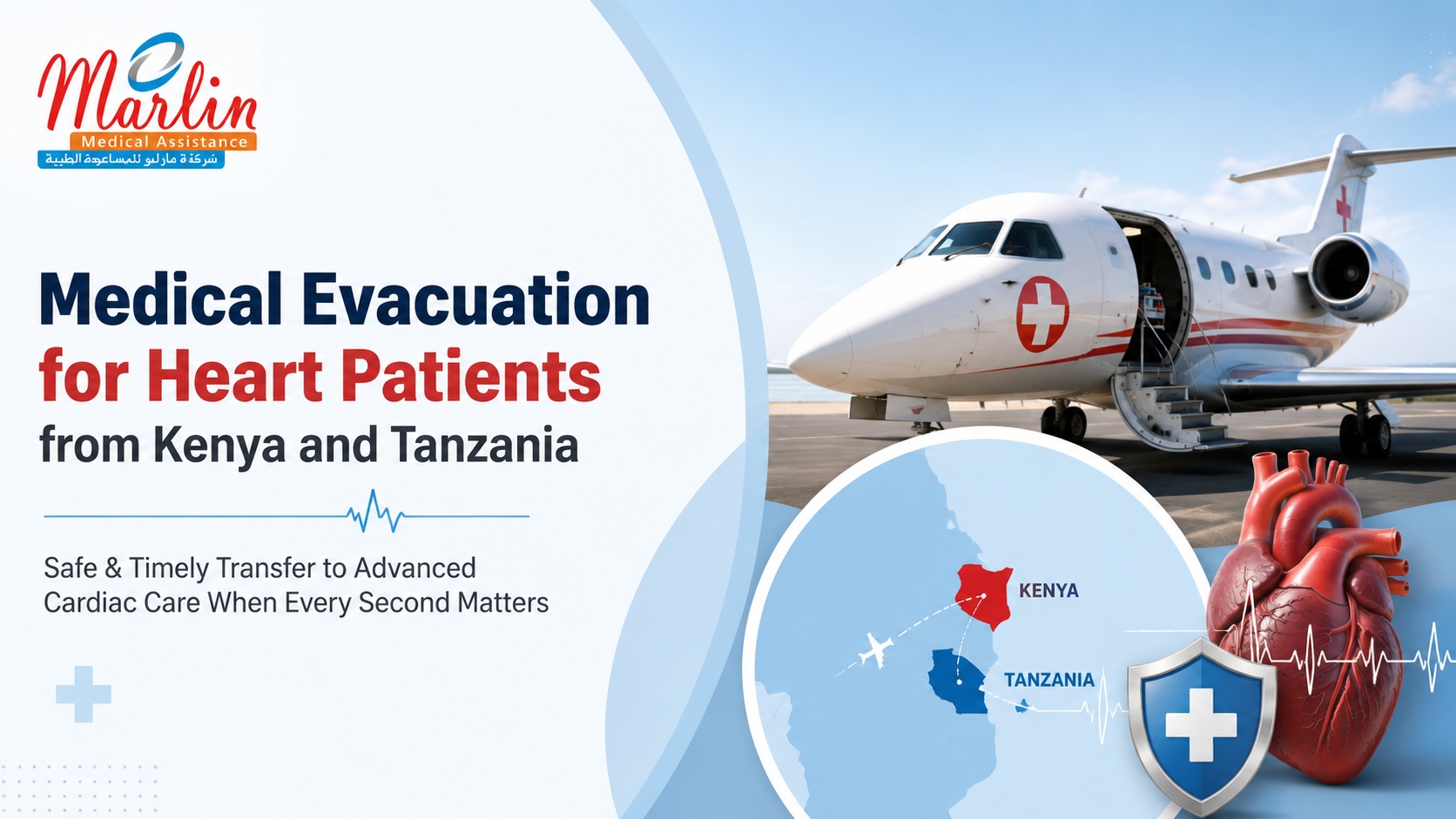
Medical evacuation (medevac) may be necessary for heart patients in Kenya and Tanzania when specialised treatment is unavailable locally or when urgent transfer to an advanced cardiac centre is required. Air ambulances equipped with intensive care facilities and trained medical teams ensure continuous monitoring during transport. Early coordination with healthcare providers improves safety, treatment outcomes, and timely access to life-saving cardiac care.
When Is Medical Evacuation Required for Heart Patients?
Medical evacuation is the movement of a patient who has a life-threatening medical condition and needs medical attention that is not available at their location through the use of an aircraft. When it comes to medical evacuation, it's a last resort after every option at hand has been exhausted and still no solution is found. Medevac is not only an option; in many medical emergencies it becomes necessary to use it. People with extreme cardiac arrhythmias, people who are heart attack prone, people who are experiencing advanced heart failure and cardiogenic shock, people with complex congenital heart diseases and people who are having complications after the cardiac surgery are amongst the categories of patients who need medevac. Medic alert is also required when a patient's doctor determines that an emergency procedure (like a coronary angioplasty, open heart or valve surgery, or heart transplant) that the local facility can't/doesn't want to handle. Aircraft or helicopters with specialized medical equipment are commonly used to transport patients, and the medical teams that accompany the transportation have to be well trained as they are the ones continuously monitoring the patient's condition, administering medications, providing oxygen or ventilatory support (if any) and responding to emergency situations. In a case of timely medical evacuations, a patient should face very few complications, a high chance of survival, and most importantly, they can be seen by a specialist and get heart care within the first golden hour of the medical event.
Most Common Cardiac Cases Requiring Medevac from East Africa
Most cardiac ailments that are reason for medically evacuation from East Africa include myocardial infarction (acute heart attacks) in need of emergency angioplasty, major heart failure or life-threatening arrhythmias, heart valve disease, congenital heart disease, and aortic dissection. Kenya and Tanzania have many first- tier hospitals offering top notch cardiac services but some complicated procedures like complex structural heart interventions, heart transplant or high-grade electrophysiology treatments might only be done at referral regional or international centres. Medical evacuation will ensure that seriously ill patients are given fast access to advanced diagnostics, specialist teams, intensive care units and life-saving interventions if they are not available locally which is quite often the case. This will affect the outcome of survival and recovery probability positively.
Where Are East African Cardiac Patients Evacuated To?
In East Africa, cardiac patients who cannot or do not get their needed treatment locally or it gets delayed get rescued to centres that specialise in heart diseases. Among the popular places patients are brought are India famous for its advanced heart surgery and low-cost treatment; South Africa, Turkey and hospitals in some parts of Europe and the Middle East. Reasons for bringing patients over include complex coronary artery bypass operation (CABG), heart valve replacement, repair of congenital heart defects, advanced electrophysiology procedures and management of heart failure. The country to which a patient is brought varies with the patient's medical condition, the level of urgency, his/ her travel stability, availability of doctors, visa requirements and insurance/funding arrangements. The medical relocation team organise either air ambulances or commercial medical escorts services to accompany patients safely and give them a medical check-up in a timely manner to patients' countries include Kenya, Tanzania, Uganda, Rwanda, and Ethiopia.
The Medical Evacuation Process - Step by Step
A medical evacuation (medevac) happens when a doctor thinks that a patient needs specialized treatment that cannot be done at the current facility. The medical team checks the patient's condition, makes sure that they are stable enough to fly, and prepares the medical record. A medevac provider will then look after the transport coordination, get travel clearance, and book the plane - commercial flight with a medical nurse or a fully equipped air ambulance given the patient's condition. On the road between facilities, doctors and paramedics on board are constantly doing patient assessment and giving treatment whenever needed. The transfer to a new facility goes smoothly if it is the same hospital or if the hospital has a good referral system. In such cases, the patient can even go from his bed to the operating table without changing doctors. The different parties working together closely, hospitals on both sides of the transfer transporters insurers, patient's family, and so on, will contribute to a smooth, fast, and safe transfer.
How Marlin Coordinates Cardiac Medical Evacuation?
We at Marlin Medical Assistance have a well-structured and planned heart medical evacuation system from one point to another, which is a safe way for transporting critically ill heart patients. After we receive a request, the doctor will evaluate the patient's case medically first, then look into their medical records, and decide which kind of transport would be best, whether a medical jet, medical escort for commercial use, or some alternative transportation. We work in partnership with specialists, receiving hospitals, the aviation industry, as well as the ground ambulance service for making smooth-handovers happen. If the requirement arises a fully skilled medical team will travel with the patient, bringing along special cardiac tools and medicines necessary to carry out the heart monitoring during the trip. We are also in charge of travel documents, medical authorizations and administrative papers and so help the patients to arrive with minimum interruption if any delays occur. This cooperation leads to the patients being taken safely and speedily to cardiac centres without any interruptions in their medical care during the entire evacuation.
Cost of Cardiac Medical Evacuation from Kenya and Tanzania
The price to fly a heart patient out of Kenya and Tanzania is dictated by a range of issues like patient's medical condition, the distance to the final hospital facility, type of aero equipment needed for this trip as well, and also the degree of health care support available on board the air craft. A short trip with a plane ambulance could set you back a few thousands USD (10,000–30,000 ) only, but an international evacuation to such destination like India, South Africa, or Europe would definitely run into tens of thousands of USDs(40,000–100,000). Generally speaking, the costs involve paying for an aircraft hire, specialist medical staff, the life-saving apparatus, the costs of the transfer by an ambulance to the hospital, obtaining flight permits, and arranging with the hospital for a place. Some travellers' insurance products plus some international sickness cover policies can potentially take either most of the evacuation cost or maybe the entire cost. Whenever transport arrangement is possible, it is a good idea to first get a clear offer through an accredited medical service company as a way of knowing the possible cost before finalizing it.
Insurance and Pre-Authorisation for Cardiac Medevac
Getting an insurance policy together with pre-authorization are among the important steps for any cardiac medical evacuation arrangements. Before the transport, the facilitator usually reaches out to the patient's insurance company first, to find out the extent of policies, whether they are the insurance company approved, as well as to see what exactly they cover for a patient needing an air ambulance, medical escorts, hospital transfers, and other charges. Quick pre-authorization is helpful in keeping everything on track and also gives clarity to the patient and family for the costs involved. There is a possibility of the insurance company not covering the cost of evacuation at all or only covering part of it. In such situations, the patient has to be ready to make a self-payment arrangement right before the evacuation mission starts. To minimize the time that they have to wait for the process, families are advised to make sure that they have insurance documents, medical notes and proofs of identity with them. It is the medical assistants who do the heavy lifting, contacting insurers, hospitals and getting everything needed signed and ready. As a result, patients' lives based on emergency transfers are saved.
Get your consultation from Marlin today