

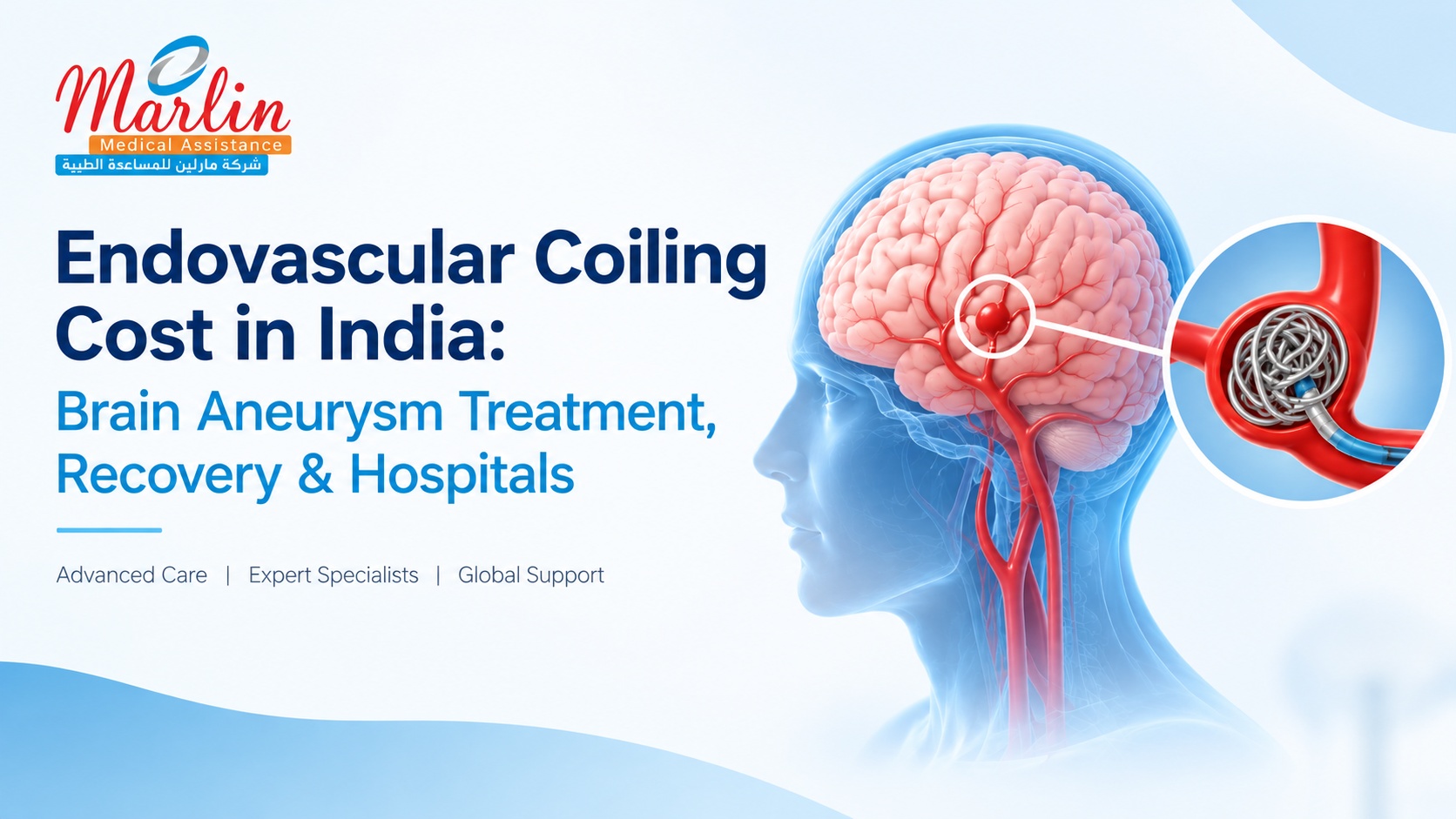
Endovascular coiling is a minimally invasive way to treat selected brain aneurysms by placing soft platinum coils inside the aneurysm to reduce blood flow into it. For international patients, the right hospital, neurovascular team, treatment plan and a clear quotation matter as much as the headline price.
A brain aneurysm can feel frightening, especially when treatment has been recommended far from home. India has established neurosurgery and neurointerventional centres, including hospitals in Delhi NCR, where international patients can access advanced imaging, endovascular treatment and critical-care support.
This guide explains how coiling works, how it compares with clipping and flow diversion, what recovery can look like, and what to consider when reviewing the endovascular coiling cost in India.
What is Endovascular Aneurysm Coiling?
Endovascular aneurysm coiling treats an aneurysm from inside the blood vessels, without opening the skull. A catheter is guided from the groin or wrist to the brain, and detachable coils are placed inside the aneurysm to encourage clotting and separate it from normal blood flow.
The procedure begins with arterial access through the femoral artery or, in suitable cases, the radial artery. Using live X-ray imaging, the neurointerventional specialist guides a catheter through the blood vessels toward the aneurysm. A smaller microcatheter is then positioned inside the aneurysm.
Through this microcatheter, the specialist delivers microcatheter platinum coils. These soft coils fill part or all of the aneurysm sac, slowing blood flow and promoting thrombosis. The goal is to prevent blood from continuing to enter the aneurysm and reduce the chance of rupture or rebleeding.
Coiling is less invasive than open surgical clipping, but it's still a serious brain procedure. Depending on the aneurysm's shape, neck, location and size, the team may use multiple coils, balloon assistance or a stent. Follow-up imaging is important because some aneurysms can show residual filling or recurrence after treatment.
Brain Aneurysm Treatment: Clipping vs. Coiling vs. Flow Diverters
| Treatment | Invasiveness | Recovery window | Commonly considered for | Device used |
|---|---|---|---|---|
| Coiling | Catheter-based, minimally invasive | Often a few days for uncomplicated elective cases | Aneurysms suitable for coil embolization | Detachable platinum coils |
| Clipping | Open brain surgery | Usually longer than uncomplicated coiling | You know what? aneurysms where direct surgical clipping is favourable | Surgical clip |
| Flow diversion | Catheter-based | Variable; follow-up and medication are important | Selected large or wide-necked complex aneurysms | Flow-diverting stent |
Recovery varies widely. A ruptured aneurysm and complications can extend intensive care and hospitalisation significantly.
Clipping vs coiling recovery time
For many uncomplicated, unruptured aneurysms, coiling allows a shorter early recovery than clipping because there's no craniotomy. Ruptured aneurysms are different: recovery is driven heavily by the brain injury caused by subarachnoid haemorrhage, not only by the procedure used.
When is flow diverter stenting used?
Flow diverter stenting is an advanced endovascular option for selected wide-necked, large or otherwise complex aneurysms, particularly when straightforward coiling or clipping isn't a suitable option. A flow diverter is placed across the parent artery to redirect blood away from the aneurysm and encourage gradual thrombosis. Stent-based treatment may require antiplatelet medication and has different risks from simple coiling.
Unruptured aneurysm treatment criteria
An unruptured aneurysm does not automatically need an operation. Doctors balance the estimated future rupture risk against the risks of preventive treatment, using factors such as aneurysm size, location, growth, symptoms, patient age, health and previous bleeding history. The European Stroke Organisation recommends multidisciplinary assessment and shared decision-making, particularly at experienced centres.
The International Patient Journey & Neuro Recovery Timeline
A straightforward elective case can often be planned around pre-procedure imaging, treatment, monitored recovery and discharge within several days, but patients with a ruptured or complicated aneurysm may need prolonged neurocritical care.
Pre-operative mapping: Your existing CT, MRI, CT angiography or MR angiography can be reviewed before travel. In some cases, cerebral angiography or DSA is required for detailed treatment planning. This step helps the specialist understand the aneurysm's exact anatomy and decide between coiling, clipping, stent assistance, flow diversion or observation.
Procedure day: Coiling is performed in a specialised angiography suite, usually with anaesthesia or sedation selected by the clinical team. The catheter is introduced through the groin or wrist and advanced to the brain before the coils are released.
Neuro-ICU stay: Many patients are monitored closely after treatment. For planning purposes, around one to two days of high-dependency or neurocritical monitoring can be reasonable in an uncomplicated case, although some patients need less and others considerably more. Dedicated neurocritical care and multidisciplinary expertise are particularly important after aneurysmal subarachnoid haemorrhage.
Total hospital stay: For an uncomplicated elective case, around three to five days is a practical travel-planning window. Some hospitals report that patients can leave after two to three days when recovery is uncomplicated.
Before flying home, the treating team should confirm stable neurological status, a satisfactory access-site recovery, medication instructions and the follow-up imaging plan. The timeline is particularly important for patients who have had a rupture, stroke, residual aneurysm filling or stent-based treatment.
For families, planning also means understanding what is included in the quotation. Ask whether surgeon fees, device costs, anaesthesia, angiography, ICU monitoring, medicines, imaging, room charges and follow-up appointments are included. This can prevent unexpected expenses during an already stressful medical journey. For you and your family.
Breakdown of Endovascular Coiling Cost in India
The endovascular coiling cost in India can vary substantially, with published estimates sometimes falling around US$4,500–US$9,500, while complex cases can cost more. The final amount depends mainly on the aneurysm, number of coils, additional stents or devices, ICU needs and length of stay.Honestly, marlin medical assistance currently lists aneurysm coiling from about US$9,100, showing why an individual hospital estimate is more useful than a generic internet range.
Patients searching for brain aneurysm surgery price Delhi should compare like-for-like quotations. A quotation for elective coiling shouldn't be compared directly with the cost of emergency surgery for a ruptured aneurysm.
Published Marlin information for brain aneurysm treatment has also shown broader India ranges depending on the technique and year of estimation. The practical lesson is simple: ask for a written, itemised estimate after the specialist reviews the scans rather than choosing a hospital from a headline number.
| Cost factor | Why it changes the bill |
|---|---|
| Number of coils | More or larger coils can increase device costs |
| Stent assistance | Adds a specialised device and medication requirements |
| Flow diverter | Usually costs more than basic coiling because of the device |
| Ruptured aneurysm | Emergency treatment and longer ICU care can raise costs sharply |
| Hospital stay | Additional inpatient or critical-care days add to the total |
| Imaging and tests | DSA, CTA, MRI and follow-up studies may be billed separately |
Top JCI-Accredited Neurosciences Hubs in India
For international patients, hospital accreditation can provide useful information about quality systems, but JCI accreditation applies to the hospital rather than a standalone “jci accredited neurocritical care” department. What matters clinically is whether the hospital has the neurointerventional, neurosurgical and critical-care expertise your aneurysm requires. Max Super Speciality Hospital, Saket, states that it holds JCI and NABH accreditation and operates as a regional hub for complex neurovascular intervention.
Medanta-The Medicity, Gurugram: Hospital profile lists an Institute of Neurosciences, advanced imaging and endovascular infrastructure, along with substantial critical-care capacity. Here's what I found it's one of the delhi ncr centres available to international patients through marlin's coordination network.
Max Super Speciality Hospital, Saket: Max describes Saket as a multidisciplinary centre with JCI and NABH accreditation and specific expertise in complex neurovascular intervention.
Marlin Medical Assistance can help international patients organise medical-record review, hospital coordination, cost itemisation, medical visa logistics and appointment planning. Its platform also provides treatment information and connects patients with hospitals and specialists in India.
Conclusion
The safest way to approach a brain aneurysm diagnosis is to start with a specialist review of the scans, not a generic price or procedure name. Coiling may be appropriate for one aneurysm, while clipping, flow diversion or careful observation may be more suitable for another.
For patients travelling to India, Delhi NCR provides access to major hospitals with neurosurgery, neurointervention and critical-care services. The right decision should be based on your aneurysm anatomy, rupture status, clinical risks, treating team's experience, expected recovery and a transparent quotation.
What's interesting is marlin medical assistance helps international patients navigate that process from medical records to specialist review, hospital coordination and travel planning. Securely upload your scans and reports, or connect with Marlin Medical Assistance on WhatsApp at +91 8984900900 for a prompt, free medical opinion from a vetted clinical board.