
Herniated disc can make day to day life difficult. Pain can be present when sitting, driving, lifting a child or sleeping well and can radiate to an arm or leg. So a lot of people then have one question – will I need an operation? The answer is usually no. Most people get better with conservative care and time. Some situations do require specialist attention and some are emergencies. This guide explains the symptoms, causes, diagnosis and treatment of herniated disc, when surgery is the right decision and what international patients should know about treatment in India.
What Is a Herniated Disc?
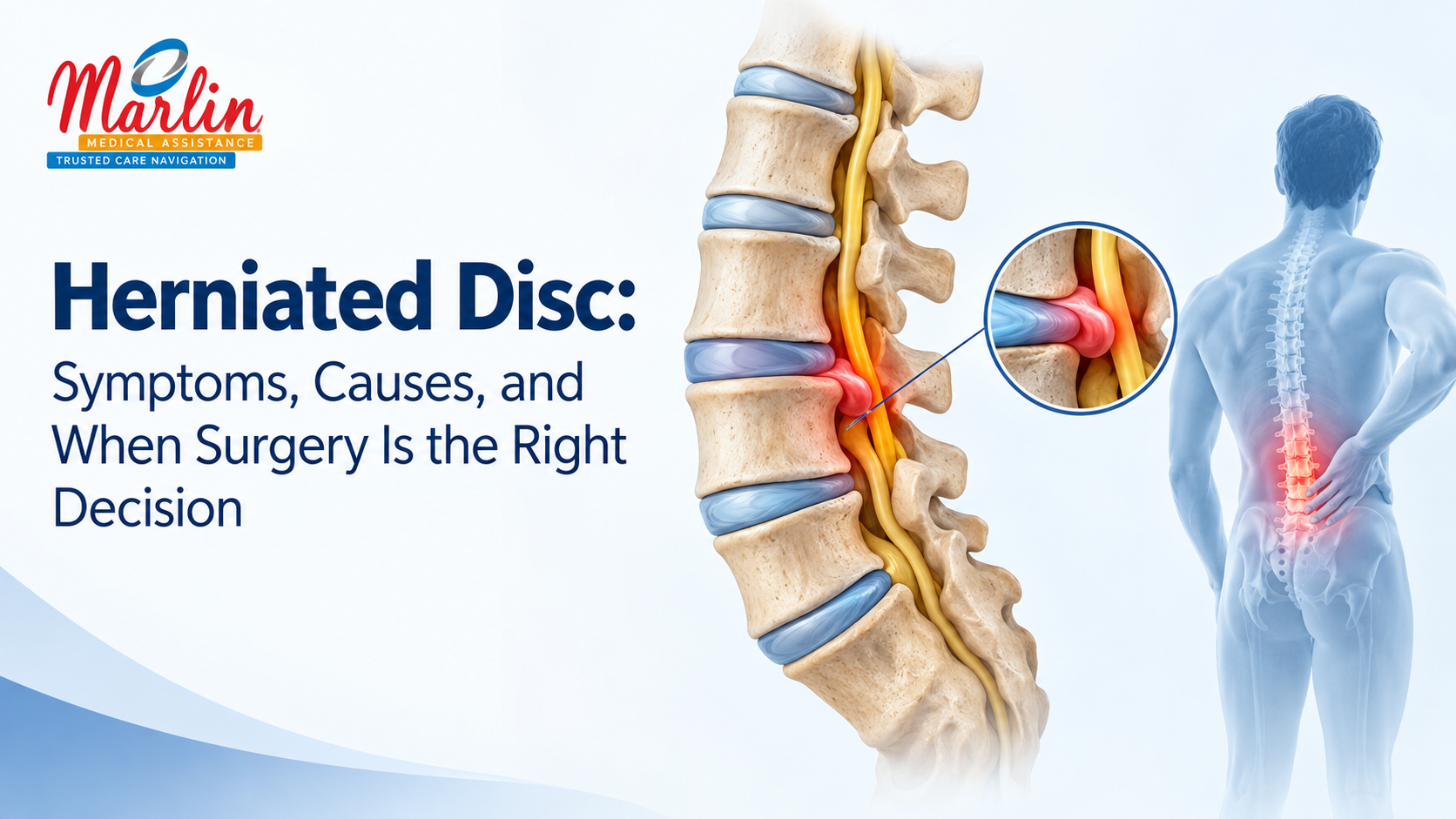
Spinal discs are the cushions between the vertebrae. Each has a hard outer ring and a soft jelly-like center. With a herniated disc, some of the center pushes through a crack in the outer ring and irritates or pinches a nerve root nearby.
• Lower back (lumbar): Most common site. It often causes sciatica - pain that shoots down the buttock, leg or foot.
• Cervical (neck): Can cause neck pain and pain, tingling or weakness in the shoulder, arm or hand.
• Mid-back (thoracic): Uncommon and less typical.
A scan finding does not necessarily explain pain, because disc changes also occur in people without symptoms. So a doctor compares three things: what you say is wrong, the neurological exam and the imaging.
Degenerative Disc, Bulging and Herniated
These terms are not interchangeable
| Term | Meaning |
| Bulging disc | The disc overflows its natural edge without the inner material breaking through. Usually painless. |
| Herniated disc | The inside material is pushing through a tear in the outer ring. |
| Degenerative alterations | Drying and thinning of the disc with age. Common, not always painful. |
| Radiculopathy | Pain or weakness in the arm or leg which are symptoms of an inflamed nerve root. |
None of these labels means surgery is necessary. Treatment depends on symptoms and findings on examination.
Causes & Risk Factors
Herniation usually develops over time.
• Age-related change: Discs lose water and elasticity, so the outer ring tears more easily.
• Strain and injury: Lifting heavy weights, particularly with twisting, repeated bending or a fall.
• Other factors: Excess body weight, smoking, family tendency and low muscle fitness.
There is no one position or activity that will cause a herniated disc, and some discs herniate without any obvious trigger.
Signs of a Herniated Disc
Some people have mild or no symptoms at all. Others say:
• Back/Neck Pain
• Pain shooting down an arm or leg
• Numbness or tingling in a specific area
• Weakness of muscle, as a weak grip or dragging foot
• Pain worsened by sneezing, coughing or sitting
Neck discs usually affect shoulder, arm and hand. Lower back disc problems usually involve one buttock and leg.
Call for emergency help right away if you have:
• New inability to urinate, loss of bladder or bowel control
• Numbness in saddle area including groin, genitals, buttocks or inner thighs
• Rapidly getting weaker in one or both legs
These can indicate cauda equina syndrome, which requires urgent assessment and sometimes urgent surgery. Please go to your nearest emergency department. Do not wait for a routine appointment or try to arrange medical transport first. New hand clumsiness or gait unsteadiness with neck symptoms should also be promptly evaluated.
Diagnosis & Investigations
Your diagnosis begins with a history and neurological examination that tests strength, reflexes, sensation and walking.
• MRI: The best test for nerves and discs. It is usually requested when symptoms are severe, persistent or progressive, neurological findings are present, or when surgery is being considered.
• X-ray: Shows bone alignment and age-related bone change, not the discs or nerves.
• CT scan: Shows bone detail and can be used if MRI is not possible.
• Nerve tests (EMG): Occasionally used when it is not clear which nerve is involved. Most patients do not need all the testing.
When Is Surgery the Right Option?
Surgery is usually a last resort after a reasonable trial of non-surgical care, and only when the problem clearly explains your symptoms. According to the Mayo Clinic, only a handful of people deal with ongoing chronic pain. Informed choice is important, and some orthopaedic sources report similar results at about one year with or without surgery.
Surgery may be considered when:
• Proper care does not halt symptoms. Another source suggests reassessment around six weeks if deficits persist and daily life is impacted. Another says if symptoms are tolerable and improving, wait longer. Timing is individual.
• Daily life is greatly limited, e.g. severe pain, loss of sleep or inability to work.
• Symptoms and scans match. The MRI shows a herniation at the level responsible for your nerve symptoms.
• There is a neurological deficit. New or worsening weakness should be evaluated in a timely manner by a specialist.
• There is an emergency, e.g. cauda equina syndrome.
Why an MRI by itself is not enough: There are many people with herniations on MRI who have no pain, and many with pain who get better without an operation. Surgery works best when scan, symptoms and examination are in agreement.
| Scheduled Surgery | Surgical Emergencies | |
| Scenario | Non-surgical care failed with persistent disabling nerve pain | Loss of bladder or bowel, saddle numbness, rapidly worsening weakness |
| Timing | Schedule led by assessments | In the hours after diagnosis |
| Where | Your decision, including medical travel | Closest appropriate hospital |
The best choice is made after discussion with a qualified spine surgeon who has examined you. Ask if your symptoms, exam and MRI point to the same disc. Ask what you have not yet tried, what happens if you wait, and why that procedure is recommended. A second opinion makes sense.
Non-Surgical Treatment Options
• Gentle activity: A short rest followed by a gradual return to normal activity is generally better than prolonged bed rest.
• Modifications to activity: Avoid heavy lifting and movements that clearly provoke pain temporarily.
• Physiotherapy: Supervised exercise to improve flexibility, core strength and movement patterns.
• Medication: Pain relievers, anti-inflammatories or nerve pain medicines, only as prescribed by your clinician.
• Injections: An epidural or nerve root injection may help to reduce inflammation and relieve symptoms for a period of time in some patients. It doesn't repair the disc.
These are not choices that everyone can make. If symptoms worsen or warning signs develop, treatment will need to be urgently reviewed.
Surgical Treatment Options
The correct operation depends on the location of the disc, the nerve involved, the symptoms, and your surgeon's judgement. The procedures are not interchangeable.
Lumbar (lower back)
• Microdiscectomy: The most common operation. The surgeon makes a small incision and removes the part of the disc that is pressing on the nerve.
• Endoscopic or minimally invasive discectomy: If indicated, access is through a very small channel.
• Fusion or disc replacement: In selected cases, such as instability. Not what you'd see with a typical herniated disc.
Cervical (neck)
• ACDF (anterior cervical discectomy and fusion): The disc is taken out from the front of the neck and the bones are fused together.
• Cervical disc replacement: An artificial disc preserves motion. It is only suitable for selected patients.
• Posterior cervical foraminotomy: Makes more space around a nerve in the back of the neck. No fusion.
Risks and Potential Complications
Risks are patient and procedure specific. Your surgical team should explain these to you before you give consent.
• General: Infection, bleeding, reactions to anaesthesia and blood clots.
• Spine specific: Nerve injury, a tear in the covering of the nerve (dural tear) and pain that lasts.
• Recurrence: The same disc or a different level can herniate again. The rates differ between studies.
• Cervical surgery: Temporary difficulty swallowing or hoarseness, stiffness in the neck, a fusion that does not join, and extra stress on neighbouring discs.
Preparing for Medical Treatment in India
If you do not have emergency symptoms and choose to seek care in India:
• Collect data: MRI images and reports, prior scans, medical history, medication list, allergies, and recent laboratory results.
• Request specialist review: Spine specialists can review documents remotely and advise if treatment may suit you.
• Get a detailed quote: Ask about what is included in surgeon fees, hospital stay, room type, implants, tests, medicines and follow-up.
• Travel planning: Your travel dates, length of stay and need for a companion will depend on your procedure and your surgeon's advice.
• Plan follow-up: Ask when you can fly home and who will see you for physiotherapy and check-ups.
Do not stop or change any medication unless instructed to do so by your treating clinician. If you have emergency signs, get care right away where you are.
Cost Comparison for Herniated Disc Treatment
There is no fixed price for herniated disc. The cost of non-surgical care is different from the cost of surgery, and each procedure has a different cost. Published ranges for lumbar microdiscectomy are shown in the table. They are from hospital and medical-travel sites, not independent surveys, so use them only for orientation.
| Country / Region | Indicative range | Source type |
| India | ₹1,00,000 to ₹5,00,000 (approximately US$1,050 to US$5,250) | Hospital website / Medical-travel portal |
| United States | US$15,000 to US$40,000 | Hospital marketing page, Aug 2026 |
| UK (private) | £7,000 to £13,000 | Hospital marketing page, Aug 2026 |
| UAE | From about US$8,200 to US$10,500 | Medical-travel portal |
No verifiable, reliable, comparable prices are presented here for cervical procedures (ACDF, disc replacement, foraminotomy). Cost varies by procedure, hospital, room category, complexity, length of stay and what the package includes. Always ask for a written itemised quote and compare like for like, including flights, accommodation and companion costs.
Herniated Disc Treatment Recovery
Recovery is variable and not guaranteed.
• No surgery: Usually improves slowly over weeks to months with activity, exercises and medication as advised. If you notice any new or worsening symptoms, tell your doctor promptly.
• Early phase after surgery: Walking is generally encouraged soon, with temporary limits on lifting, bending, twisting and driving. After surgery on the neck you may have a sore throat or mild difficulty swallowing.
• Return to activity: Desk work, then heavier work and sport, which usually take longer, will be advised by your surgeon.
• Rehabilitation and follow-up: Physiotherapy builds strength and review visits assess healing. Some numbness can take time to settle down.
• Travel home: Your surgeon will determine when it is safe to fly. Arrange for discharge summaries, scan reports and operative notes, and organise follow-up at home.
Understand Your Options with Marlin Medical Assistance
Have you been diagnosed with a herniated disc, but are unsure of what to do next? Marlin Medical Assistance can help you understand the treatment options and connect you with the right specialists and hospitals in India. Marlin is a care navigation partner, not a treatment provider.
You can share your existing MRI reports and records. There is no obligation, and the decision about surgery is between you and your doctors. If you have emergency symptoms, go to urgent care where you live first.